
How AI Can Complement Your Solopreneur Business Decisions
Let AI assist with research and planning.

If you're like me, you make a dozen decisions for your solo business every day. A lot of them are easy. But every so often, you feel yourself getting stuck and unsure of how to move forward — like changing your offers or switching to a different tool.
The problem for most solopreneurs is that they're deciding alone. There's no one to bounce your ideas off of. Even if you've gathered a lot of research, there's no one to push back or challenge you to think differently.
That's where AI has found its place in my solo business decision-making. It can't make a decision for me, but it can be a sounding board — especially if you give your AI tools the right context.
Why is decision-making so hard when you run a business solo?
When you run a business by yourself, you're the entire org chart in a single person. You're the one pulling the numbers, and you're the one who has to live with whatever you decide. There's no colleague to poke holes in your logic before you commit.
In Simply Business's survey of solopreneurs, 61% said that they underestimated how hard it is to manage all business functions on their own. Before going solo, I spent years on the executive team at a tech company, where other executives and managers were part of every decision. Working alone, I quickly realized how much the direction of my business depended on the decisions I made alone.
A couple of things make this even harder. Information about your business is everywhere. You've got some data in a spreadsheet, brand guidelines in a PDF, and client information in three separate Google Folders. On top of that, some of your constraints (like your time and budget) live only in your head.
Good decision-making also takes time you don't have, so you go with your gut or avoid making a decision altogether (which can come back to bite you). You've got to find ways to make decisions quickly and confidently.
A framework: how to use AI to complement your business decisions
Business decisions tend to move through a few stages, from gathering your business context to actually pulling the trigger. (And somewhere in between is your research and a gut-check). AI can help at every step. Here are a few ways to get started.
1. Put all your decision context in one place
Every time you open a fresh AI chat, you start over — re-explaining what you do and who you serve. It's time-consuming (and frustrating) because you just want to get to the decision-making part of an AI conversation.
Instead, you want to give AI a lot of background about who you are and what you do. In HaloMate, for example, you can set up a Project. It's a workspace that holds your business info, your research, and whatever constraints you're working under. You set up the context once, so you're not repeating yourself.
In my business projects, I include information like:
- Background information about me
- Audience descriptions
- A voice and tone (how I write for different platforms)
- Templates I use for email sequences, landing pages, etc.
- My current goals for this year
Different from other AI project features you might have tried before, these aren't static files you upload and forget. They're live documents that you and the AI both edit, and everything's versioned so you can roll back changes. If you're working through a decision over multiple days, the workspace evolves with your thinking.
You can also set up different Mates for different types of decisions. For example, one handles business strategy, and another handles content. Each Mate has its own memory — your business strategist doesn't see your content calendar, and your content assistant doesn't need to know your revenue goals.
Instead of starting each conversation from scratch, your business context is already there. Every question or conversation is answered based on your actual situation. Not generic solopreneur advice.
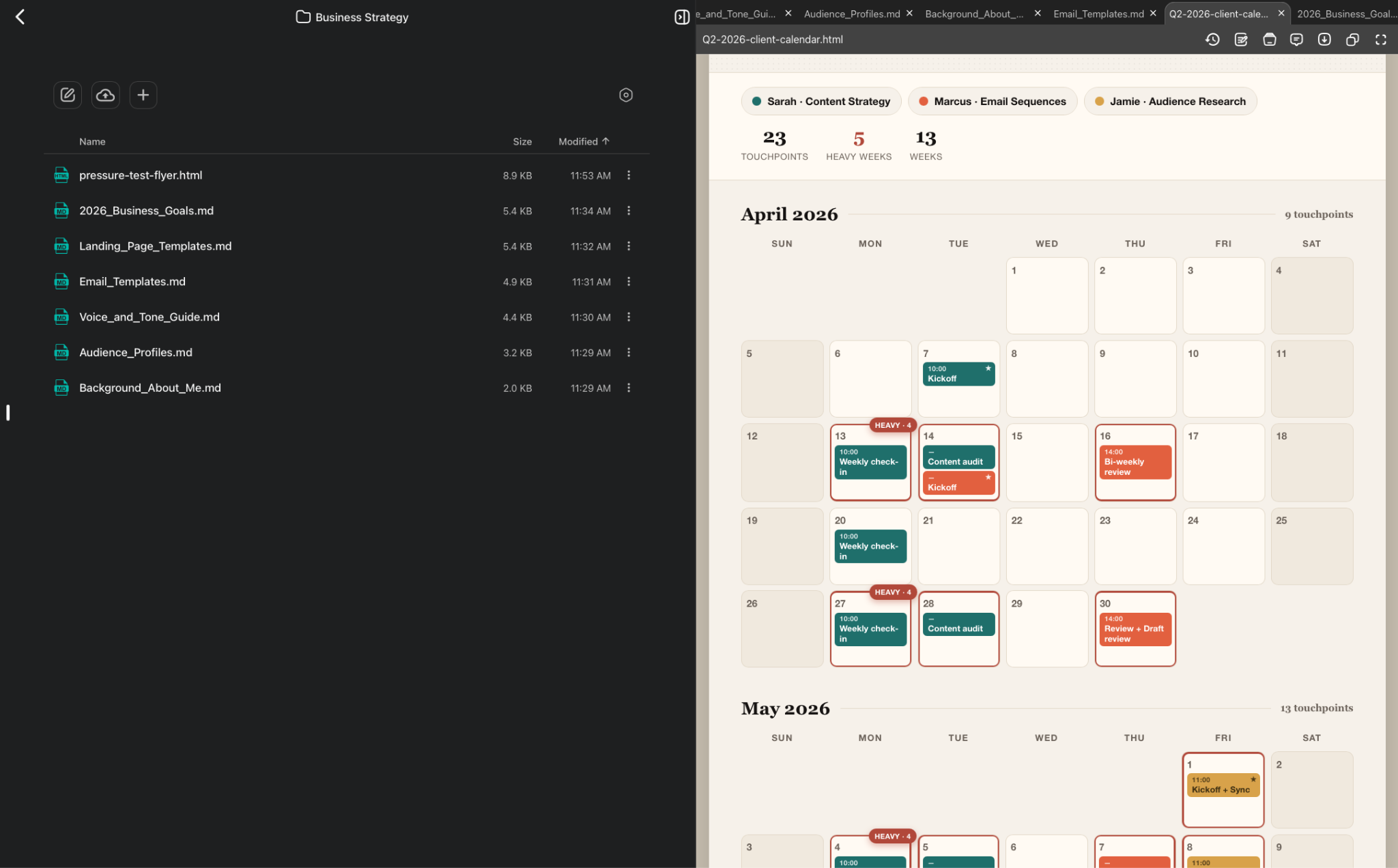
For example, a Business Strategy Hub can hold all of your business context. You, along with your AI assistants, can always write back to the hub with updated versions.
2. Let AI do the research legwork — with sources you can check
Once your context is set, the next step is research. Before AI, this was often the biggest time suck for me. Let's say I was researching a new tool. I'd have to visit individual websites, compare features and pricing, and look for honest reviews on sites like TrustPilot or Reddit. Plus, it was often hard to gauge if the product would meet my needs.
HaloMate's AutoPilot does that multi-step research for you, and it shows its work. Every claim comes with a source you can click and check.
This is the step where AI has saved me the most time. When I was recently weighing whether or not to change tools, AI did all the research, and I could have a back-and-forth conversation about my specific needs. Far better and more useful than simply reading through a list of features.
3. Get a second opinion across models
Every decision ultimately ends with a judgment call. And that part can feel uncomfortable when you're using AI for research — one model can hand you an answer that sounds completely sure of itself. Another model might say, "Have you thought about…?"
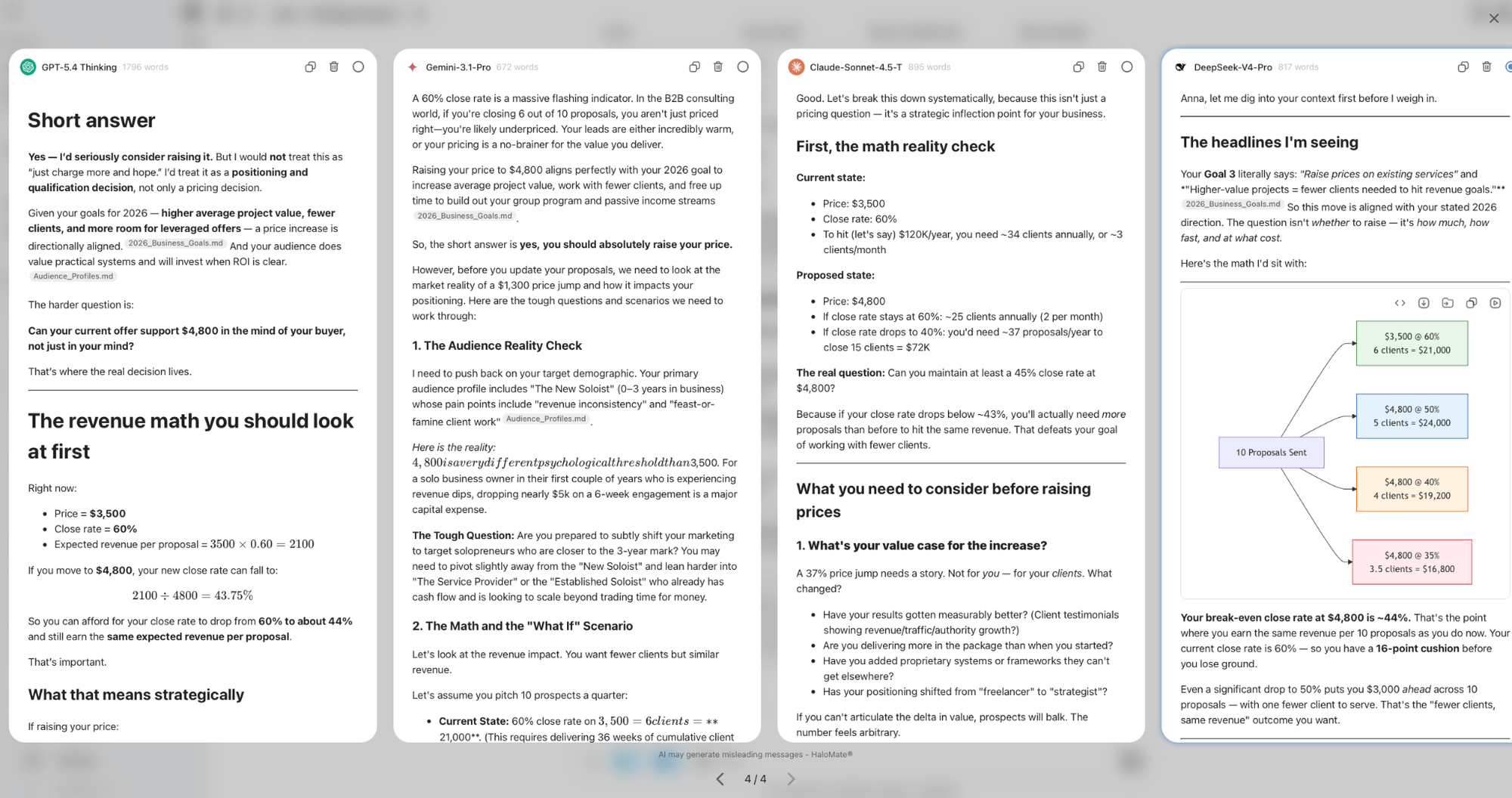
HaloMate lets you run the same question across different models like ChatGPT, Claude, and Gemini, side by side. If you ask the same question across all three and get the same response, great! You can move forward with more confidence. And when they don't agree, that split is actually useful. You can read through the responses and reasoning and consider different angles.
Here's how this might actually work for a solopreneur business decision. Let's say you're considering a new pricing strategy. In HaloMate, you can ask three models whether or not a price increase makes sense, based on your business context (set up in a project).
- One model fixates on the potential increase in your revenue.
- One model questions what the market will pay.
- One model considers what the new price says about your brand.
Let's say you ask three models the same pricing question. Seeing them side-by-side helps you see blind spots you may not have considered.
4. Turn the analysis into something you can actually decide from
Once you've got your research and opinions from a few different models, you still have to decide what to do. But a wall of text can be hard to process.
Instead of re-reading paragraphs of analysis, ask AI to turn the findings into a visual breakdown. That way, you can actually see the tradeoffs. In HaloMate, your notes and references stay in a sidebar.
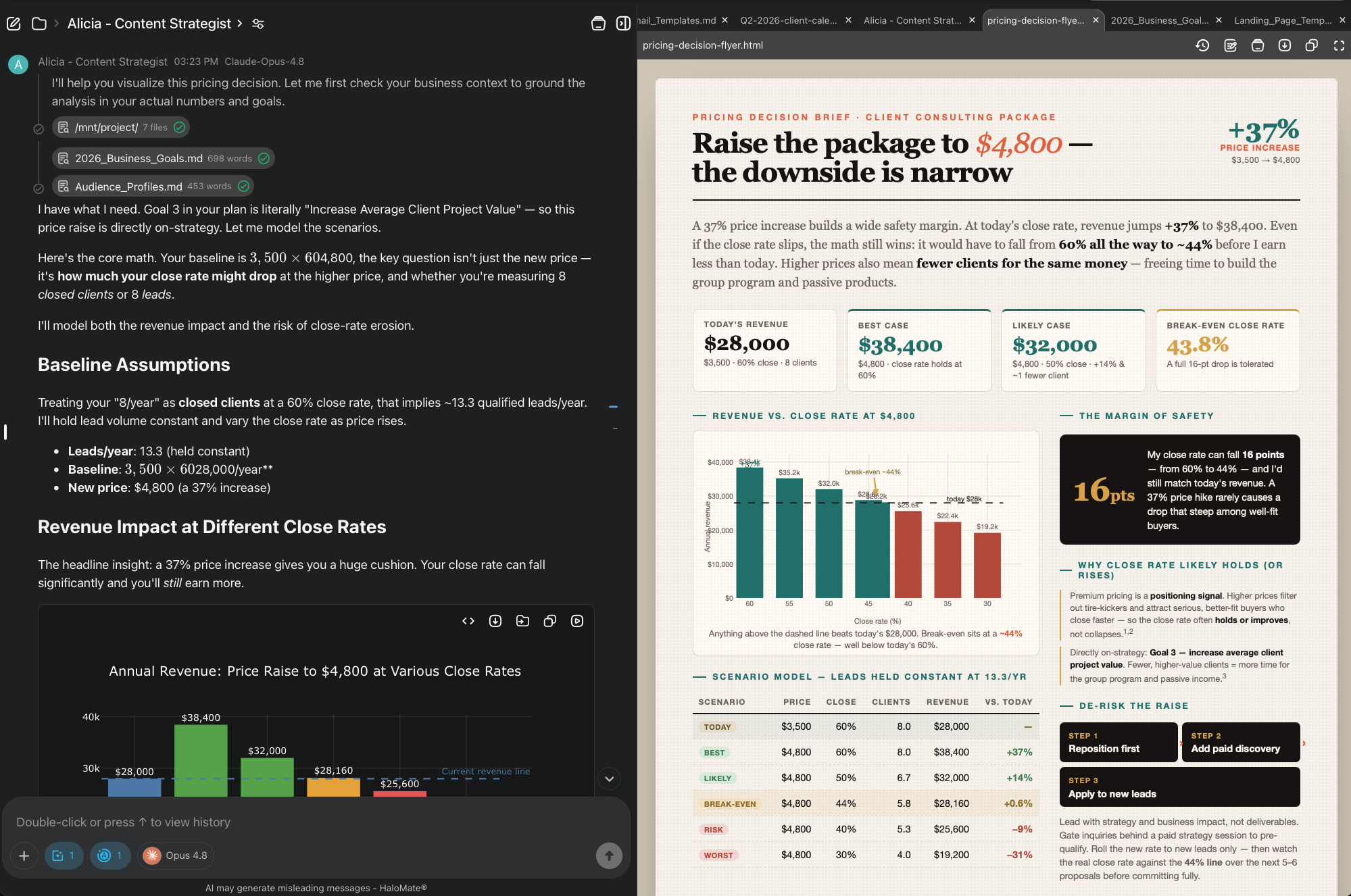
Everything stays in the Project. If you need to revisit the decision later (which often happens), you can pull up the same workspace and pick up right where you left off.
When AI should NOT be the one weighing in
AI can help with a lot of solopreneur business decisions, but not all of them. A few scenarios are better off without AI. Knowing which ones keeps you from handing over judgment calls that should stay yours.
Don't use AI to make decisions about:
- Your values as a solo business owner
- Relationships with your customers or your audience
- Anything that doesn't have data to back it up or where you can't verify the results
These decisions are inherently human, and AI isn't a substitute. AI can sound superbly confident with every response, but point you in the wrong direction. In chat conversations with AI, I've actually said, "No, that's wrong and here's why." But even with that, I'm thinking about why it is wrong for my business.
Every business decision should be backed up with something, whether it's context, research, or data. Without it, AI is giving you nothing more than a guess.
Your first steps for AI-assisted business decisions
If you want to try using AI to complement your business decisions, start with Step 1: getting all of your business context in one place. If information only exists in your head, get it written down. (You could even dictate information, get a transcript, and feed it to an AI project). It will make all subsequent steps so much easier.
What makes all of this effective is persistent memory (which HaloMate has). The tool actually remembers your business from one decision to the next. You explain yourself once, and every decision after that starts from a place that already knows who you are and how you operate.
If you're ready to use AI to complement your business decisions, try HaloMate and set up your first Project.
FAQs
How do solopreneurs make better business decisions?
Start by gathering all of your business context — such as financials, goals, audience info, and constraints — in one place. That way, every decision is based on your actual situation. Use research (your own or AI-assisted) to fill in gaps, then weigh tradeoffs before committing. Your goal should be to make decisions quickly and with confidence.
Can AI help with business decisions?
Yes, AI can handle research, surface tradeoffs, and give you a second opinion when you don't have a team. Tools like HaloMate let you compare responses across multiple AI models side by side. With that type of visibility, you can spot blind spots before you commit. AI works best as a complement to your judgment, but isn’t a replacement for it.
What business decisions do solopreneurs face most often?
Common decisions include pricing your services, choosing which tools to invest in, and how to allocate your time. These come up frequently because solopreneurs have to fill every role in their business, from strategy to execution.
Why is decision-making harder as a solopreneur?
When you run a business alone, there's no colleague or manager to challenge your thinking or catch what you may have missed. Your business information is often scattered across multiple tools. Additionally, the time pressure of solo work means decisions are often rushed or avoided altogether.
What should you not use AI for in your business?
Avoid using AI to make decisions about your values, your client relationships, or anything where you can't verify the output. AI can sound confident even when it's wrong. Treat it as a research tool and a sounding board rather than the final decision-maker.